Share
Everyone Is Building an App to Help You Meet People. We Built a Room.
On loneliness, algorithms, and why a door that stays open until midnight still does what no platform can.
We counted. There are at least a dozen apps right now whose entire pitch is: we will help you meet people. Timeleft matches you with five strangers for dinner based on a personality quiz. Bumble added a whole mode just for finding friends. WeRoad raised $150 million to send groups of strangers on trips together. There is an app called 222 that pairs you with people and sends you all to the same wine bar. Another called Friending that intentionally limits how much you can text, because the whole point is to get you in the same room as another person.
These are not small experiments. Friendship apps pulled in over $16 million in U.S. consumer spending and 4.3 million downloads in the past year. The investors are serious. The demand is real. And the underlying problem is not subtle: more than half of Americans say they are lonely. Two in ten adults have no close friends outside their family. That number was three percent in 1990.
So here is the question nobody seems to be asking. If the problem is that people are not in the same room together, why is the solution another screen?
A $400 Billion Problem with a Very Simple Answer
The U.S. Surgeon General called loneliness a public health epidemic in 2023. The World Health Organization says one in six people on the planet deal with it persistently. The economic cost in the U.S. alone runs past $400 billion a year in healthcare, lost productivity, and absenteeism. And venture capital looked at those numbers and did what venture capital does: fund software.
We get it. The market logic is clean. But there is a disconnect between diagnosing a physical problem and prescribing a digital solution. A personality quiz can match you with a compatible stranger, but it cannot replicate the thing that actually happens when you are sitting somewhere and live music starts and the person next to you catches your eye because the pianist just did something unexpected. That moment is not engineered. It is not optimized. It just happens, because you were both in the same room.
Eventbrite published their 2026 research and the headline was "Reset to Real." Nearly eight in ten young adults said they now prioritize spontaneity over a planned experience. Nine in ten want things that connect them to their own neighborhood. The data is pointing in one direction: people do not want another platform. They want a place.
The Places That Used to Do This Are Disappearing
There is a name for the spaces that sit between home and work. The coffee shop where you know the barista. The bar where you end up talking to the person on the next stool. The bookstore that somehow always has the same regulars on Saturday. These places used to carry entire neighborhoods.
In 2019, about two-thirds of Americans spent time in a public community space regularly. By 2025, that number dropped to roughly half. Independent spots close. Rents push out the walkable, small-footprint places that made neighborhoods feel like neighborhoods. What replaces them is chains, or nothing.
That gap is what the apps are trying to fill. But the gap is not digital. It never was. It is a missing room.
People do not want another platform. They want a place. A room where the social part happens because the room gives you a reason to be there.
What This Actually Looks Like
We did not set out to compete with Bumble BFF. But when we look at what No More Cafe does on any given week, the overlap is hard to ignore. On Thursdays, a jazz musician plays to a room of thirty people who mostly did not know each other when they walked in. On Wednesdays this month, artist Harrison Love has been building a large-scale oil painting live in the space, layer by layer, and the same guests keep coming back to watch it evolve. The NYC Backgammon Club runs game nights here. During the day, independent workers and creatives use the space as a focused work environment that shifts into the social evening.
None of this requires a download. There is no profile to build, no quiz to take, no algorithm deciding who you should sit next to. You walk in. Something is happening. You stay. And because you stayed, you end up in conversation with someone you would not have met otherwise. Not because a platform matched you. Because the room created the conditions.
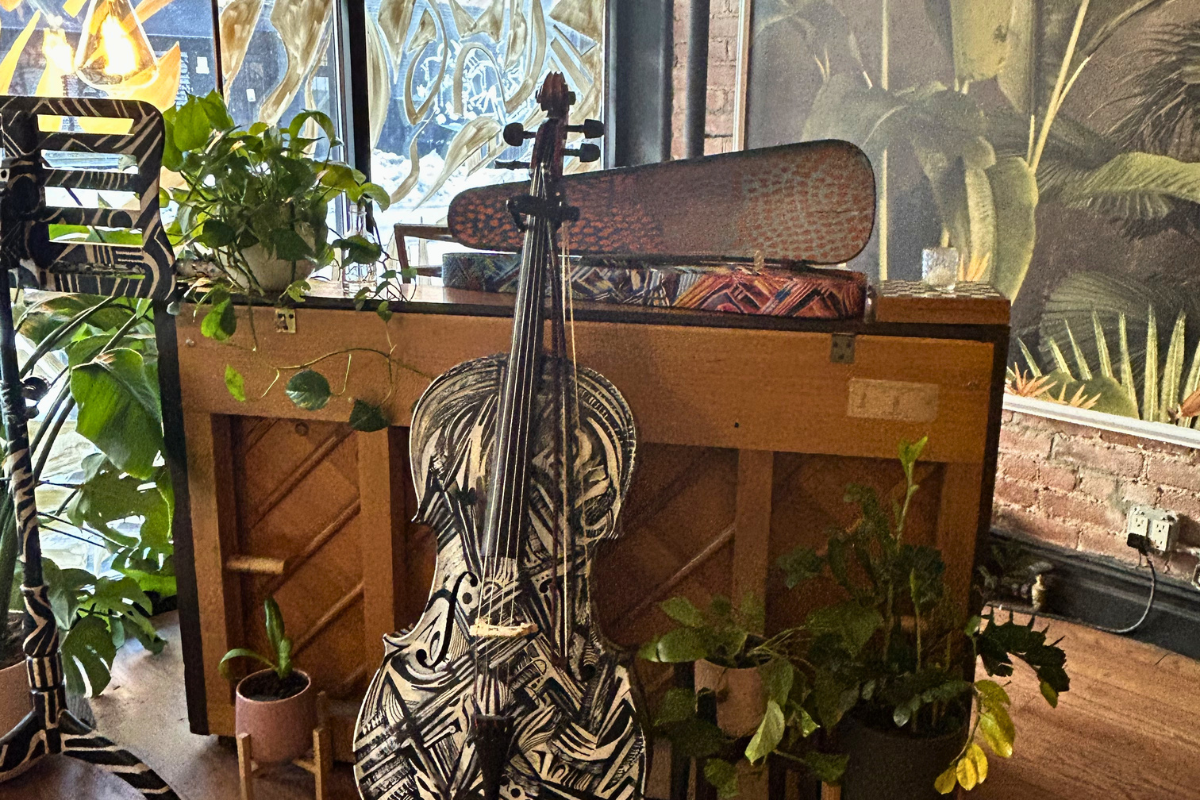
Earlier this month, we hosted EPI: Mural and Music, a collaboration where live violin looping shaped the creation of a 15-by-6-foot mural in real time. Sound influenced paint. The audience was not watching from behind a rope. They were at their tables, drinking, talking, watching two forms of craft respond to each other in the same room. That kind of experience does not scale through an app. It scales through the door being open.
The Best Social Experiences Have No Social Pressure
Here is what the research keeps confirming and what anyone who has been to a good bar already knows: the best connections happen when connection is not the stated goal. Eventbrite calls it "soft socializing." You show up for the activity. The social part takes care of itself.
This is the difference between an app-mediated experience and a room. When you match with a stranger and show up to dinner, there is an expectation. You are there to connect. You have to be interesting for two hours. The pressure is the structure. When you walk into a space because there is live music or a game night or an artist working on the wall, the pressure is gone. You are there for the thing. And because the thing is good, you end up talking to the person next to you about it.
No More is open from noon to midnight, seven days a week. That range matters. You can come in at two in the afternoon with your laptop and still be here when the evening starts. The space does not ask you to commit to a social format. It just stays open and keeps giving you reasons to be there.

The Room Is Open. So Is the Conversation.
We are always looking for the next thing that brings people through the door. Musicians, visual artists, game designers, community organizers, cultural programmers, anyone building something that works in an intimate room with a built-in audience. If you have an idea for a collaboration, a residency, or a recurring event, we want to hear it.
Reach us at info@nomorecocktails.shop or through our Happenings page.