Share
The Bottle Size Never Lies: What Bars Really Think of Non-Alcoholic Drinks
Ignore the trend pieces, in both directions. The real state of the non-alcoholic category is written on the back bar, in glass, in milliliters.
The press has spent five years announcing that non-alcoholic drinks are the future of the bar. The bars have been answering that claim the whole time, in writing, and almost nobody reads the answer. It is the size of the bottle, and how many of them there are.
Ask for a cocktail without alcohol at some very good restaurants right now, rooms with stars, and here is what happens. Someone opens a small single serve bottle, the same bottle you can buy chilled at the bodega on the corner, pours it into a coupe, and hands it over at sixteen dollars. That format is a confession. This is a building where the kitchen would treat jarred chopped garlic as a firing offense, where nothing is allowed to arrive premade, and the bar just served you retail product as house work. They would never do that with anything else in the building. They did it with this, because this is the one category they do not believe in.
The headline has been wrong twice
If you want to know why I trust bottles over articles, consider Boisson. Founded in 2021 on the pandemic wave, it raised way over 20 million dollars, some of it from Pernod Ricard's venture arm, opened multiple non-alcoholic bottle shops across three states, and became the standing exhibit in every story about the future of drinking. In April 2024 it filed for bankruptcy and closed every store. The same publications that had crowned it flipped within days: was it all hype, is the non-alcoholic market drying up.
The category answered the eulogies by crossing a billion dollars in US retail the following year, growing about 22 percent while alcohol sales slipped. So the boom coverage was wrong, then the bust coverage was wrong, and both were wrong the same way: they read a story instead of a shelf. The demand was real. The narrative about its speed was not, and every one of those stores was priced off the narrative.
The boom coverage was wrong, and then the bust coverage was wrong, and both were wrong the same way: they read a story instead of a shelf.
Alcohol waits. Nothing else does.
To read a shelf you need one piece of bar math, and it starts with a quiet subsidy nobody thinks about: alcohol is its own preservative. Open a bottle of liquor, pour one drink a year from it, and it sits on the back bar patiently. That is why a bar can afford a hundred whiskeys nobody ordered this month. Alcohol waits.
Wine barely waits. A glass of wine is priced so the first pour roughly pays for the bottle, and the math has one condition: the bottle has to sell through before it dies, and it has days. That is why not every bottle in a restaurant is offered by the glass. By the glass is a bet on velocity, and every bottle that loses the bet goes in the trash.
Now take the alcohol out entirely and the clock speeds up. A non-alcoholic bottle dies in a couple of days, refrigerated. And the one that somehow does not, the one that stays fine for a month? Read its label. It is full of things you do not want to be drinking. The category with the least proven demand carries the shortest honest clock in the building.

A bottle is a forecast
One non-alcoholic wine by the glass is not an offering. It is a forecast: this venue expects to sell four glasses within two days. Two labels means eight. No labels means they do not think it is possible right now. You will not walk into a regular place and find ten non-alcoholic wines by the glass, because that menu would be a forecast no honest operator is prepared to sign.
Which is why the customer at that list saying I wish they had more options, they are losing money, I would have bought one, has it backward. The one glass is real. One glass this Friday does not underwrite a bottle that dies on Sunday. The customer holds a glass, the press holds a growth rate, the venue holds the bottles it threw away after someone ordered exactly one glass. The venue is the only one whose number was bought at full price.
The rush to small, and the road back
You can watch this category's entire history in packaging decisions, in order. The first wave of brands arrived with full-size bottles and pitched them to bars, assuming they would be poured like everything else behind the bar. The volume was not there. Venues could not see the problem yet, and a big bottle at low velocity is trash on a schedule.
So everyone rushed small, and the package shrank to the size of one seating. A bar had to sell the bottle before it spoiled, and the customer at home was no more committed: nobody curious about a new category wants to gamble forty dollars on a bottle they have to finish by Thursday. The single serve solved both sides at once. Sealed, cheap, no clock, no commitment. Non-alcoholic wine scrambled into half bottles for the same reason.
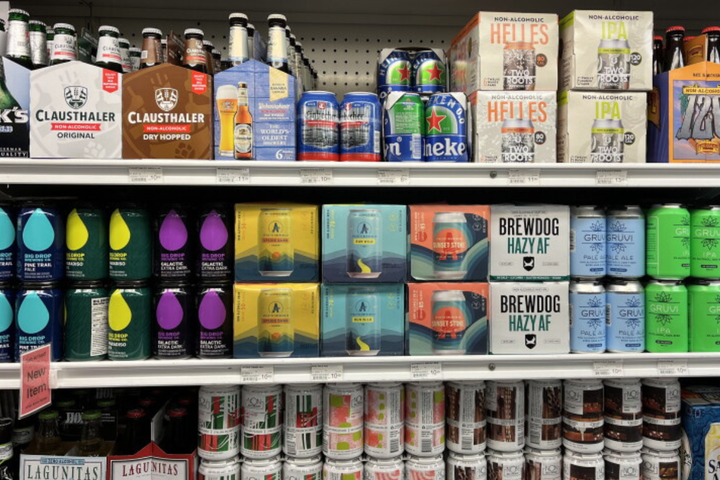
Now the road back has started. Demand is up, the customer shows up night after night, and full-size bottles are being pushed into bars again. Bottle sizes are the category's real growth chart, drawn in glass: big, then small, then big again, tracking belief the whole way.

The catch-22, and how venues square it
A bar today needs a legitimate non-alcoholic list, because the non-drinker increasingly decides where the whole group goes, the way the vegan in the group picks the restaurant, and because the guest who alternates through the night compares your non-alcoholic pour to the cocktail you just built, same night, same glassware. People go from good to good. Nobody zebra stripes between good and bad.
But the same venue is throwing bottles away. A broad list says you believe, the trash can says the demand is not there yet. The single serve is how venues reconcile the two: belief on the menu, nothing in the trash. For a neighborhood spot with three non-alcoholic orders a week, that is a defensible answer.
At a serious room it is something else, because a serious room eats spoilage every single day and calls it standards. The kitchen tosses fish trim and day-old bread. The bar dumps yesterday's citrus every afternoon and juices fresh again. Nobody upstairs calls that a loss, it is the price of being good. The only category in the building where the clock becomes a reason to serve retail product in a coupe is this one. And a non-alcoholic cocktail built from scratch uses the same juice, the same herbs, the same syrups the bar already stocks and already throws away. The trash argument was never real for cocktails. What is left is belief, or its absence.
The test from your seat takes ten seconds. They either make you something, shaker, aeration, a garnish, a drink finished in front of you, or they open you something. A venue that makes the drink believes you will come back. A venue that gives you a can is waiting for you to leave.
One non-alcoholic wine by the glass is a forecast: four glasses in two days. The day a bar lists multiple wines by the glass, the argument is over.

Read the shelf, not the news
The shelf has never once been wrong.
Count non-alcoholic wines by the glass, year over year. Today the honest number at most places is one, or none.
The day an ordinary bar lists multiple wines by the glass, because it expects to sell them, is the day demand has started to catch up with the narrative. The shelf will publish the verdict before the press does.