Share
What Was a Temperance Bar? We Already Ran This Experiment.
The alcohol-free bar gets talked about as a new idea. Temperance bars ran for about a century on two continents, they were real bars, and one of them is still open.
A temperance bar was a bar that served no alcohol. Not a cafe and not a juice counter. A bar: a counter, stools, someone mixing drinks to order, a printed list with names on it, and in the bigger ones, billiards in the back. Britain had them on the high street from the 1830s. America had one inside nearly every drugstore in the country by the early 1920s.
They were not built to sell a beverage. They were built to do the job a bar does in a person's life, at a moment when the bar had been taken away. That is why they were shaped like bars. In America you can watch it run both ways: outlaw the saloon and alcohol-free bars appear everywhere within two years, make drinking legal again and the same rooms turn into lunch counters.
It started with seven men in Preston
In 1832, seven men in Preston, Lancashire, led by a cheesemonger and printer named Joseph Livesey, signed a pledge to give up all alcohol, not just spirits. They were called total abstainers, then teetotallers, a word another Preston man coined.
Livesey saw the problem right away. England in the 1830s had almost no meeting place that was not a pub, so a man who signed the pledge had nowhere to spend an evening. In 1833 he opened a temperance hotel in Preston, the first, and by November 1835 there were twenty-two across the north and the Midlands. The Band of Hope, founded in Leeds in 1847 to sign up children, counted 3,238,323 members by 1897, the year Queen Victoria became its patron. That many pledges needed somewhere to go.
What they got was the temperance bar: concentrated in the industrial northwest, working class, selling herbal cordials, mineral waters and what the trade called mock ales across a counter.

The one that is still open
Mr Fitzpatrick's in Rawtenstall, Lancashire, opened in 1890, run by a family of herbalists from Ireland. It still makes dandelion and burdock to the recipe they brought with them.
It was one branch of a family chain across Lancashire, 24 outlets by one account and 40 by another. Every other branch closed. This one survived on a devoted local trade, which is a fair description of what it takes.
Boston built one that looked like a saloon
America built the same idea and built it to look like the thing it was replacing.
On February 1, 1882, Charles Sumner Eaton, an MIT educated druggist in his mid twenties, opened a temperance saloon on Washington Street in Boston, on Newspaper Row, at the address of the city's first licensed tavern, granted to Samuel Cole in 1633. He named it Thompson's Spa after his wife's maiden name so nobody would make jokes about his own.
Everyone called it the Temperance Bar, because that is what it was. A bar rail, men in white coats, tables and chairs, billiards. Mineral waters imported from France and Germany and a printed list of alcohol-free cocktails with names like Next Morning and Moxie Nerve Food. Eaton's stated reasoning was that temperance would be advanced by places that sold non-alcoholic drinks and made the opportunity for sociability prominent. The room was the argument. It filled the building within a year, turned a profit in six months, and within five years was selling around 1,200 egg phosphates on a humid summer day.
Thompson's opened in 1882 as a bar with no alcohol and closed in 1958 as a lunch counter.
Prohibition made it national
Then federal law did in one move what the movement had spent ninety years doing by hand. Prohibition took effect in January 1920 and closed every legal drinking room in the country. The drugstore was standing right there, and druggists already owned the carbonation equipment. By the early 1920s nearly every drugstore in America had a soda fountain, and soda sales rose 200 percent in the first six months.
Nobody kept a real count, and the numbers do not agree. Drugstore industry accounts put the height at roughly 100,000 fountains. Another line of sources puts the peak at 48,000 in the 1940s, falling to about 5,000 by the 1970s. Those are two different counters counting two different things, and there is no settling it from a desk. What is firm is the proportion: near universal in drugstores at the peak, gone from most pharmacies by the 1970s.
What was actually in the glass
Mostly it was tart, which is the part people get wrong. A phosphate was acid phosphate, phosphoric acid and mineral salts, mixed with soda water and a flavoring. Lemon and cherry were the common ones, and an egg phosphate added a raw egg. Sarsaparilla was ground bark, root, spearmint and eucalyptus, shaken and topped with carbonated water. Dandelion and burdock, the British side of the shelf, was roots and sugar. An egg cream has never contained an egg or any cream.
The person making these was a soda jerk, named for jerking the handle that pumped the syrup. Coca-Cola sold itself for years as the great national temperance drink. In Manchester in 1908, a herb and spice wholesaler named John Noel Nichols mixed grapes, raspberries, blackcurrants and a private list of herbs into a purple tonic, registered it as a medicine under the name Vim Tonic, and shortened it to Vimto in 1912. It is still on shelves.
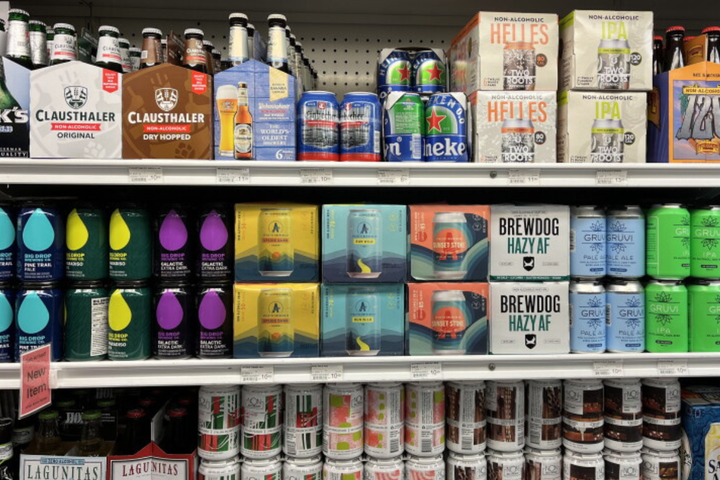
So is one number. The 0.5 percent line the Volstead Act drew in 1919 is still why a grocery store cards you for a non-alcoholic beer.

What happened when the bars came back
Repeal came in December 1933 and the fountains did not close. This is the part that usually gets told wrong. The raw count kept climbing and peaked in the 1940s.
What ended was the job. Once there was a legal bar on the corner again, the alcohol-free room had to earn the visit on its own, and most could not. They stopped competing for the evening and sold food instead. Through the 1940s the trade merged into ice cream parlors, malt shops and lunch counters. Then the body went too: the war took the soda jerks and rationed the sugar, and afterwards bottling, home refrigeration, supermarkets and fast food finished what was left.
Thompson's is the whole arc at one address. It opened in 1882 as a bar with no alcohol. It added ice cream in 1915, had eleven locations in downtown Boston by 1939, and was known by then for sandwiches, doughnuts and pie. The last two closed in 1958 as lunch counters. Britain's dates are messier and the sources disagree about the cause, but the outcome is not in dispute. One is left.
Nobody chose the alcohol-free room over the bar. For a hundred years it was what was left.

The difference this time
The temperance bar never won a customer. For a century it received them, first from the pledge and then from the law. The reason to walk in was borrowed, and when the saloon came back the reason went with it. The rooms that lasted stopped being copies of a bar. One became a lunch counter. One became the only place that makes a certain drink.
The new alcohol-free bars are running the same experiment from the other end, and most are ending the same way. People are still being sent. The pledge is back under a different name, and someone who has decided not to drink still needs somewhere to spend an evening. But a pledge comes and goes. It has a season and an end date, and the bar on the corner has neither. A room cannot live on borrowed visits.
The coffee shop shows what winning looks like. It sits next to a bar, serves drinks all day, and nobody calls it doomed, because it is not a bar with something missing. A person who drinks goes to a coffee shop for one experience and to a bar for another, and never confuses the two. Now imagine a coffee shop that serves only decaf, for everyone who loves sitting in a coffee shop but would rather skip the caffeine. It sounds absurd, and it is the business plan of the alcohol-free bar. Every temperance bar made that mistake and most new ones repeat it: copy the bar, remove its main draw, and hope. A copy of an experience only wins while the original is closed.
So the room that works will not be a bar with the alcohol taken out, and it will not be a coffee shop either. It has to be something new, an evening that does not have a name yet, one a person who drinks would still choose over both. The history does not say that room cannot be built. It says nobody has built it yet.


Make sure to follow us on Instagram for new blog posts and event updates, or come visit us in the East Village.
Follow @nomore_cafeEditorial note. This piece is a history, not legal or medical advice. Counts for American soda fountains vary widely by source and are flagged as disputed above. Dates for the decline of the British temperance bar differ between sources.