Share
Who Profits When You Drink Non-Alcoholic Beer? Usually the Company That Sold You the Beer.
Drinking less was supposed to cost the big brewers. The drink people switch to is more and more often theirs, and their own CEO says it sells at premium margins.
When Americans drink less, the beer companies lose. That is the assumption, and it is half right. They lose the beer. Then, more and more often, they sell you the drink you switched to, and they make better money on it.
The first half is real. Citi reported that US beer shipments fell 3.9 percent in the first nine months of 2026, and if that pace holds, the year ends below 1980 levels. Regular beer is shrinking, and nobody at the big brewers pretends otherwise.
The second half is the part that gets left out of the headlines, though the companies say it plainly to their investors. In the same Citi analysis, non-alcoholic beer is the only part of the category with a durable growth path, and Citi says about 98 percent of the category's growth is coming from just five brands. That is a market with a few winners.
Who makes the non-alcoholic beer you buy
The best-selling non-alcoholic beer in America, as of early 2026, is Michelob Ultra Zero, according to Circana data. It launched in January 2025 and took the top spot from Heineken 0.0 in about a year. Anheuser-Busch held three of the top five: Ultra Zero first, Budweiser Zero third, Busch NA fourth. Heineken is a beer company too. So is Molson Coors, which plans to take Coors 0.0 national in 2027.
Non-alcoholic beer was supposed to be the thing that pulled people away from big beer. The independents that built the category, Athletic the largest of them, are still growing. But the top of the chart reads like the beer aisle with the alcohol taken out, because that is what it is.
Is non-alcoholic beer cheaper to make?
It depends on who is making it.
Most non-alcoholic beer starts as beer. Then the alcohol comes out, through a vacuum still, a membrane or a spinning cone, and the beer has to be pasteurized or filled sterile because there is nothing left in it to keep it. We went through what that equipment costs in why non-alcoholic drinks cost what they cost: from half a million dollars to over a million for one machine.
That cost is fixed. A small brewery pays for the machine with a few thousand barrels. A brewer the size of AB InBev pays for it with a volume where it disappears. Alfa Laval, which sells the equipment, puts the running cost of its large dealcoholization modules in Europe at 2.8 euros a hectoliter. A hectoliter is about 280 cans. That is roughly one euro cent a can. It is the seller's own number, so treat it as the seller's number, but it tells you the order of magnitude. It is the same thing we found on the wine shelf, where who owns the machine sets the price.
Then the tax. A malt drink under 0.5 percent alcohol is not taxed as beer. A brewer that size pays $18 a barrel in federal tax on its beer, about five cents a can, and New York adds a few cents more. Small numbers. They still point one way.
Now put the can on the shelf. Michelob Ultra Zero sells for close to what Michelob Ultra sells for.
Sit with that. At the top of the market, the expensive step is close to free, the beer tax is gone, and the price barely moved.
At the top of the market, the expensive step is close to free, the beer tax is gone, and the price barely moved.

Where the money goes on one can
Taking the alcohol out at scale: about one euro cent, by the equipment maker's own estimate.
Federal beer tax skipped: about five cents.
Price on the shelf: close to the beer's.
So who makes money when you drink less?
AB InBev's chief executive answered that on the October earnings call. Michel Doukeris said non-alcoholic used to be less than 1 percent of the company's business and is now “approaching 2%.” Then, without any fuss: “non-alcohol is at a premium margins for us.”
Premium margins. Not a loss leader, not a public service, not a hedge. The drink that was supposed to cost them customers is one of the better things they sell.
And here is the line that should change how you read every story about Americans drinking less. Doukeris estimated that about 60 percent of the company's non-alcoholic volume comes from “new occasions and new consumers.” By the brewer's own count, most of it is not a beer drinker switching. It is a moment when a beer was never on the table, or a person who was never going to buy one. To the brewer, that is not a lost customer. It is a new time of day to sell into.
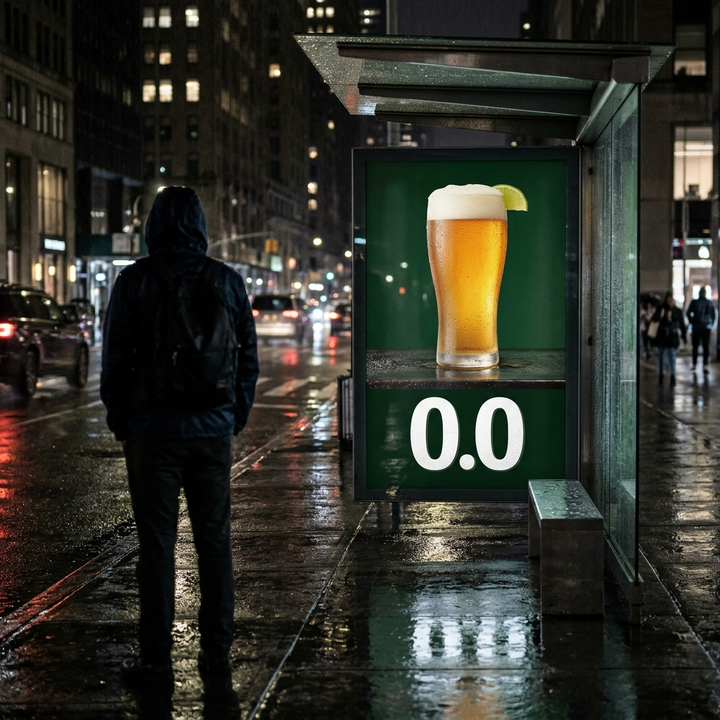
So the loss is real, and it is softened twice. Once by the drinker who switches and stays with the same company. Again by the drinker who was never theirs and now is. That is also why the 0.0 logo is everywhere, which we covered in why non-alcoholic beer is advertised everywhere.
To the brewer, that is not a lost customer. It is a new time of day to sell into.

Spirits are a different story
If the tax were the story, spirits would be the place to look. Federal tax on a 750ml bottle of 80 proof liquor, at the rate the big producers pay, is about two dollars. A non-alcoholic spirit skips all of it. And yet the non-alcoholic spirits shelf is still a small one, full of independent names. The big spirits companies bought in early, as we covered when everyone bet on sobriety, and that shelf still looks nothing like the beer chart.
The same-company story is a beer story. Beer has the scale, the machines, and a customer who already orders by brand name. Put a zero next to the name and the customer follows the name.

Same name, nearly the same price
The drink you switched to is often made by the company you switched from. It costs them about a cent more to make, skips a few cents of tax, and sells for close to what the beer sells for.
What it means for the can in your hand
If you drink less to cost the beer industry money, it is not working the way you think. If you drink less because you feel better, it is working fine, and the brewer is happy to help.
A zero from a big brewer keeps your money where it was. A zero from an independent puts it somewhere new, and the price on that can carries a machine paid off over far fewer cans.
I would bet Coors 0.0 arrives in 2027 priced like Coors. There is no reason to charge less. That is not a scandal. It is just who wins when people drink less.


Make sure to follow us on Instagram for new blog posts and event updates, or come visit us in the East Village.
Follow @nomore_cafe